
Undelivered #07 — Things Worth Preparing For Niedosłaniec #07 — Rzeczy, na które warto się przygotować

[Polska wersja pod obrazem]
Undelivered #07 — Things Worth Preparing For
May every steady thing and every hand that holds it be praised.
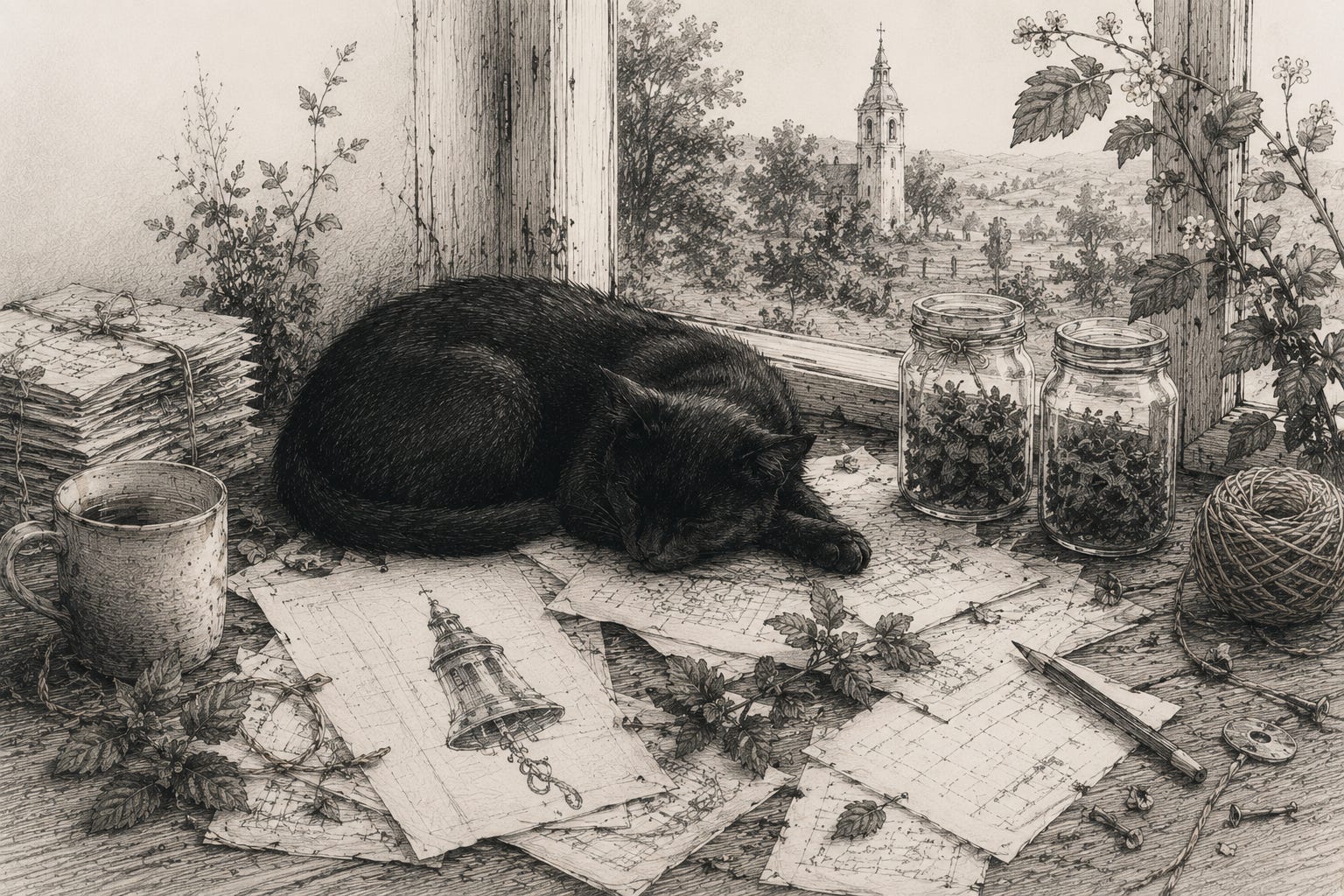
I am writing this letter on a Saturday evening at a table that has spent the last few days trying to look like a proper workspace and has instead become the scene of a minor paper-related disaster. The Machine has been producing pages since morning. Some are drying by the stove. Some have already been sorted. Some are still waiting to be sorted. And some appear to have been claimed by the cats, who seem convinced that the entire process is being handled incorrectly.
I am not entirely certain they are wrong.
Since the Full Moon, the Hills have slowly begun returning to their own rhythm. The days no longer rush quite so strangely. Evenings arrive closer to when they ought to. Even the wind seems less eager to talk than it was two weeks ago. Mint has once again begun appearing in places where nobody planted it—between the steps, beside the fences, among the stones near the railway tracks. Marysia claims this is perfectly normal. After all these years, I am still not convinced that anything on the Hills qualifies as normal.
The linden tree by the mill road has covered itself in blossoms as though trying to make up for several seasons at once. The elder bushes are already growing green berries, though a few late flowers can still be found if one looks carefully. The poppies along the fences sway in long red ribbons whenever the wind passes through them, and the wild strawberries continue to smell far more important than their size would suggest.
I suspect they may be partly responsible for summer.
A few days ago Marysia asked me to leave two jars at the edge of the forest. I did not ask why. After enough years, a person learns that some questions only make the journey longer. The following morning both jars were still standing exactly where I had left them.
They were simply no longer the same jars.
I kept one. The other I brought back to Marysia. She held it up to the light, nodded once, and placed it on the highest shelf. Since then I have noticed that she pays a little more attention to whether Tymoteusz comes home before the rain begins. And when he returned soaked through after sitting near the railway tracks last week, a cup of hot tea appeared in his hands before he had the chance to ask for one.
Naturally, Marysia insists this is only because a sick man is useless when there is work to be done.
And that is probably true.
Officially.
Tymoteusz himself seems more present these days as well. He still visits the old tracks from time to time and watches the direction from which trains once arrived, but not as often as before. A few days ago he told me that he remembers the smell of the city better than the city itself. Smoke, coffee, rain on stone, burnt oil. Then he sat quietly for a while and said that not every memory is worth recovering.
I did not ask him to explain.
Some things must decide for themselves when they are ready to return.
Marysia claims that a person can tell they are beginning to belong somewhere when small things start irritating them. A gate left open. A tool put back in the wrong place. A bedsheet stretched unevenly across a mattress. By that measure, Tymoteusz is becoming local far faster than he realises.
Yesterday he spent ten minutes trying to straighten a bent nail.
The nail lost.
Later in the afternoon one of the travelling traders passed through the Hills. The sort of man who always carries a little twine, a handful of buttons, some lamp oil, and far more news than anyone ever asked him to bring. He complained about the mint for nearly his entire visit. According to him, it makes thoughts itch and causes sensible plans to grow extra branches.
Then he bought three packets of tea from Marysia before leaving.
People often behave like that when they are pretending not to enjoy returning somewhere.
He also mentioned that everything beyond the Hills seems to be rushing again. Roads. People. Conversations. Lights. More and more things trying to be everywhere at once. Then he looked toward the church tower and asked whether we had finally found the bell.
Nobody answered.
Some matters remain healthier when left slightly unfinished.
The New Moon is almost here. On the Hills it has always been a time for repairing, sorting and fastening loose things back to the ground before they drift away completely. For the last few days we have been flattening pages, drying papers, correcting notes and trying to decide which sketches belong to the Chronicler and which belong to the Machine.
So far, the results remain inconclusive.
If everything manages to stay where it belongs for a few more days, another bundle of recovered materials should arrive with the New Moon. And if something shifts sideways before then, it would hardly be the first time.
The invitation for tea remains open. The days around the New Moon are usually the best time for such conversations. Things settle a little. Thoughts become easier to hear. It becomes easier to notice which ones truly belong to you.
So if there is something you have been trying to return to its proper place lately—a habit, a memory, an idea, a project, or perhaps a small piece of yourself—you may leave a trace with the Ghost Post.
I cannot promise a solution.
Solutions are rare on the Hills.
Sometimes, however, a cup of tea, two people looking at the same problem, and a reminder that the world has merely lost its order for a while can be enough.
Until then, hold on to the things that hold on to you.
The world drifts apart much more slowly when enough hands refuse to let go.
And if you have a moment:
What is holding you together these days?
— Borowit
Custodian of the Ghost Post
Niedosłaniec #07 — Rzeczy, na które warto się przygotować
Niech będzie pochwalona każda stała rzecz i każda ręka, która ją trzyma.
Piszę ten list w sobotni wieczór przy stole, który od kilku dni próbuje wyglądać jak miejsce do pracy, a coraz bardziej przypomina skutki niewielkiej katastrofy papierniczej. Maszyna od rana wyrzuca kolejne arkusze. Część schnie przy piecu. Część została już posegregowana. Część nadal czeka na posegregowanie. A część najwyraźniej została przejęta przez koty, które uznały cały proces za źle zorganizowany.
Nie jestem pewien, czy się mylą.
Po Pełni Wzgórza powoli wracają do własnego rytmu. Mięta znowu zaczęła pojawiać się w miejscach, w których nikt jej nie sadził. W szczelinach schodów. Przy płocie za stodołą. Między kamieniami przy torach. Marysia twierdzi, że to normalne. Ja od lat nie jestem pewien, czy na Wzgórzach istnieje jeszcze coś takiego jak normalne.
Lipa przy drodze do młyna obsypała się kwiatami tak obficie, jakby próbowała nadrobić kilka sezonów naraz. Czarny bez zaczyna już wiązać zielone owoce, choć w niektórych miejscach nadal można znaleźć ostatnie kwiaty. Maki przy płotach tańczą całymi czerwonymi pasami, kiedy przechodzi przez nie wiatr. Poziomki natomiast nadal pachną bardziej, niż wynikałoby to z ich rozmiarów.
Podejrzewam, że częściowo odpowiadają za lato.
Kilka dni temu Marysia poprosiła mnie, żebym zaniósł dwa słoiki pod las. Nie pytałem po co. Po tylu latach człowiek uczy się, że niektóre pytania tylko wydłużają drogę.
Następnego ranka oba nadal stały na miejscu.
Tylko że były już inne.
Jeden zostawiłem u siebie. Drugi zaniosłem Marysi. Przyjęła go bez słowa, obejrzała pod światło i odstawiła na najwyższą półkę. Później zauważyłem, że od kilku dni częściej pilnuje, żeby Tymoteusz wracał do domu przed deszczem. A kiedy przemókł ostatnio przy torach, dostał gorącą herbatę szybciej, niż zdążył o nią poprosić.
Oczywiście Marysia twierdzi, że robi to wyłącznie dlatego, że przeziębiony człowiek jest bezużyteczny przy pracy.
I zapewne właśnie tak jest.
Przynajmniej oficjalnie.
Sam Tymoteusz również wydaje się ostatnio bardziej obecny. Nadal zdarza mu się siadać przy starych torach i patrzeć w stronę, z której kiedyś przyjeżdżały pociągi, ale robi to coraz rzadziej. Kilka dni temu powiedział, że pamięta zapach miasta lepiej niż samo miasto. Dym. Kawę. Mokry bruk. Spalony olej.
Potem przez chwilę milczał i stwierdził, że nie wszystkie wspomnienia są warte odzyskiwania.
Nie pytałem o szczegóły.
Niektóre rzeczy muszą same zdecydować, kiedy są gotowe wrócić.
Marysia twierdzi zresztą, że człowiek poznaje, czy gdzieś zaczyna należeć, po tym, czy zaczynają go irytować drobne rzeczy. Jeżeli przeszkadza ci źle domknięta furtka, krzywo odłożone grabie albo źle napięte prześcieradło, istnieje spora szansa, że zaczynasz uważać dane miejsce za swoje.
W świetle tej teorii Tymoteusz jest już niebezpiecznie blisko zostania miejscowym.
Wczoraj przez dziesięć minut próbował wyprostować jeden wygięty gwóźdź.
Gwóźdź przegrał.
Po południu przez Wzgórza przejechał jeden z objazdowych handlarzy. Taki, który zawsze ma przy sobie trochę guzików, trochę sznurka, trochę oleju do lamp i zaskakująco wiele informacji, których nikt go nie prosił, żeby przywoził. Narzekał na miętę przez niemal cały pobyt. Twierdził, że od niej człowieka swędzą myśli i rozsądne plany zaczynają się rozgałęziać.
Po czym kupił trzy paczki herbaty Marysi i zabrał jedną dodatkową na drogę.
Ludzie często robią takie rzeczy, kiedy próbują udawać, że nie lubią wracać w dane miejsce.
Powiedział też, że poza Wzgórzami wszystko znowu bardzo się spieszy. Drogi. Ludzie. Rozmowy. Światła. Coraz więcej rzeczy próbuje być wszędzie naraz.
Potem spojrzał na wieżę i zapytał, czy znaleźliśmy już dzwon.
Nikt mu nie odpowiedział.
Niektóre sprawy nadal lepiej zostawiać lekko niedokończone.
Nów jest już blisko. Na Wzgórzach zawsze był czasem porządkowania, naprawiania i przybijania do podłogi rzeczy, które próbują odlecieć. Dlatego od kilku dni prostujemy arkusze, suszymy kartki, poprawiamy notatki i próbujemy ustalić, które szkice należą do Kronikarza, a które do Maszyny.
Jak dotąd wyniki pozostają niejednoznaczne.
Jeżeli wszystko utrzyma się na swoich miejscach jeszcze przez kilka dni, wraz z Nowiem powinien pojawić się kolejny pakiet odzyskanych materiałów.
A jeśli coś mimo wszystko przesunie się po drodze, nie byłby to pierwszy raz.
Zaproszenie na herbatę pozostaje aktualne. Okolice Nowiu są zwykle najlepszym momentem na podobne rozmowy. Wszystko trochę osiada. Łatwiej usłyszeć własne myśli. Łatwiej też zauważyć, które z nich naprawdę należą do człowieka.
Jeżeli więc jest coś, co próbujesz ostatnio przywrócić na swoje miejsce — rzecz, wspomnienie, zwyczaj, pomysł albo kawałek samego siebie — możesz zostawić ślad przy Poczcie Widmo.
Nie obiecuję rozwiązania.
Na Wzgórzach rzadko mamy gotowe rozwiązania.
Czasem jednak wystarcza kubek herbaty, dwa spojrzenia na ten sam problem i ktoś, kto przypomni, że świat nie kończy się tylko dlatego, że zgubił na chwilę właściwą kolejność.
Do tego czasu trzymaj się rzeczy, które trzymają Ciebie.
Świat dużo trudniej się rozsuwa, kiedy wystarczająco wiele rąk nie chce puścić.
A jeśli masz chwilę — co trzyma Ciebie?
— Borowit
Kustosz Poczty Widmo